


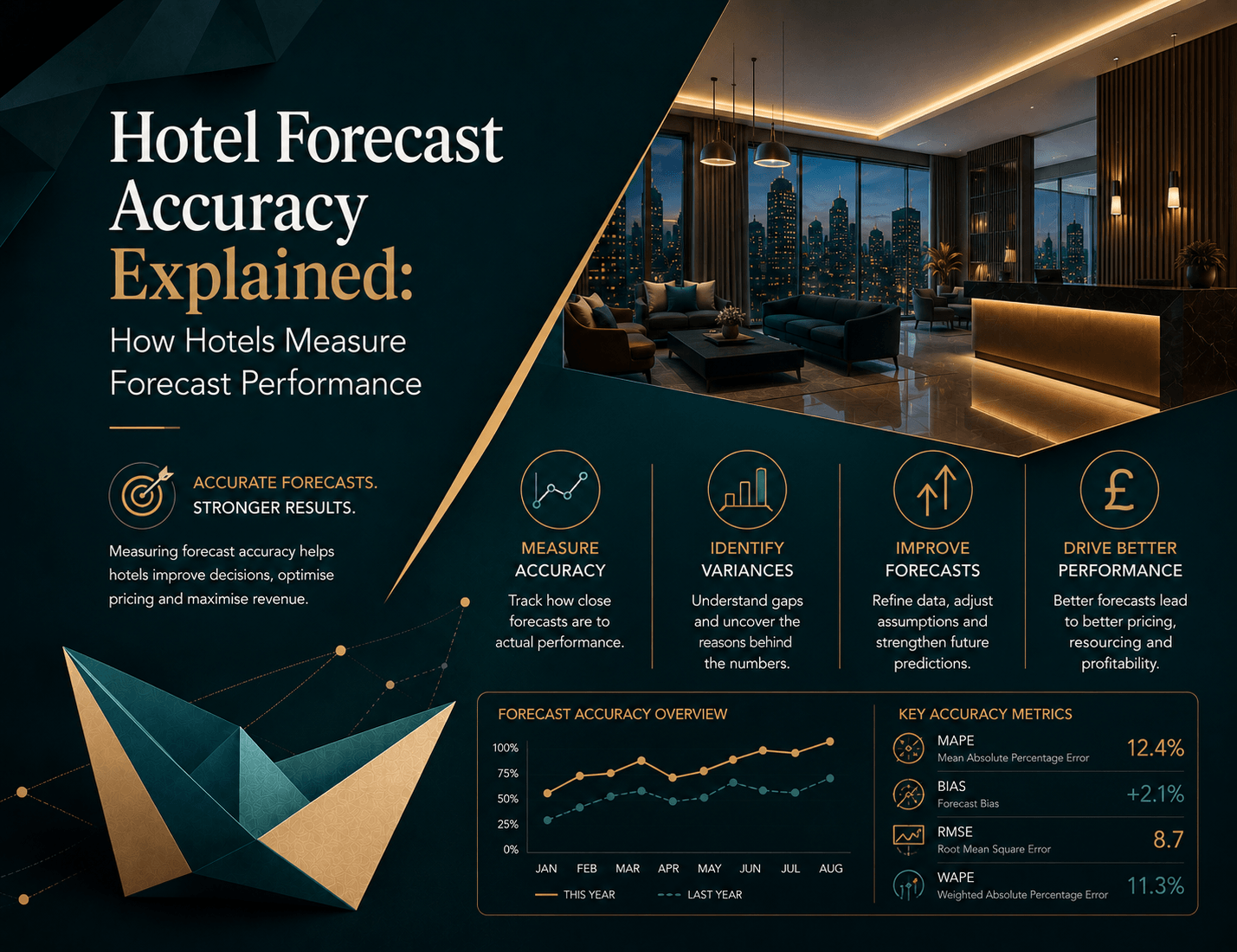
A hotel forecast can appear credible when it is prepared, but its quality becomes clearer once the trading period has passed. A revenue team may predict 85% occupancy, an Average Daily Rate of £180 and £30,600 in room revenue, yet the hotel could ultimately achieve 72% occupancy at £165.
The difference between the forecast and the actual result can reveal whether the hotel understands its booking patterns, cancellation behaviour, market segments and future demand. Forecast accuracy measures how closely a hotel’s predictions reflect the business that eventually materialises.
Accurate forecasting does not mean predicting every trading date perfectly. Hotel demand can change because of customer behaviour, economic conditions, transport disruption, events and other unexpected factors. The purpose of measuring forecast performance is to identify repeated errors, understand where assumptions are failing and improve future forecasting decisions.
What Is Hotel Forecast Accuracy?
Hotel forecast accuracy measures how closely forecast performance aligns with the actual result achieved by the hotel.
The comparison can be made using rooms sold, occupancy, Average Daily Rate (ADR), room revenue or other commercial measures. If a hotel forecasts 180 occupied rooms and ultimately sells 175, the rooms forecast was relatively close to the final outcome. If the hotel sells only 120 rooms, the much larger difference suggests that expected demand did not materialise or that the forecasting assumptions significantly overstated the likely result.
The numerical difference alone does not explain why the forecast was inaccurate. Expected pickup may have failed to arrive, cancellations may have exceeded normal levels or a major group booking may have been lost.
Forecast analysis therefore examines both the size of the error and its commercial cause.
Why Forecast Accuracy Matters
Forecasts influence decisions across a hotel before the final trading result is known.
Revenue teams use expected demand to guide pricing and inventory controls. Sales departments assess whether additional business is required. Housekeeping and front office managers use occupancy expectations when planning labour, while food and beverage teams may use forecasts when estimating covers and purchasing requirements.
Finance departments also rely on revenue forecasts when assessing expected financial performance.
Repeated overforecasting can cause hotels to schedule excessive labour, purchase unnecessary stock or delay commercial action because management believes stronger demand is still expected.
Persistent underforecasting creates different risks. Hotels may operate with insufficient staffing, fail to protect room rates or accept lower-value business because the strength of future demand was not recognised early enough.
Forecast accuracy matters because the forecast becomes a planning assumption. If that assumption is repeatedly wrong, commercial and operational decisions may be based on a distorted view of future business.
Forecast Error and Variance Explained
Forecast error or forecast variance describes the difference between a predicted result and the actual outcome.
A hotel that forecasts 170 occupied rooms but ultimately sells 150 has a difference of 20 rooms. If forecast room revenue was £32,000 and actual room revenue reached £29,000, the revenue difference is £3,000.
Hotels may report variance as a numerical amount, percentage or percentage-point difference depending on the metric being measured.
The direction of the calculation must be consistent. Some reports calculate actual performance minus forecast, while others calculate forecast minus actual. Hotels should use one methodology so managers clearly understand whether a positive or negative number represents performance above or below forecast.
Simple forecast errors can also become misleading when several dates are combined.
Suppose a hotel overforecasts demand by 20 rooms on Monday and underforecasts demand by 20 rooms on Tuesday. Adding the two differences produces a net variance of zero.
The forecast was not perfectly accurate. It was wrong by 20 rooms on both days.
For this reason, hotels may use measures that examine the absolute size and direction of forecasting errors.
Which Hotel Metrics Can Be Forecast?
Hotels can measure forecast accuracy across several commercial metrics. Each provides a different view of forecasting performance.
Rooms Sold
Rooms sold compares the number of occupied rooms expected with the number ultimately sold.
If a hotel forecasts 140 rooms and sells 135, the forecast is five rooms away from the final result. Rooms variance provides a direct measure of whether the hotel correctly estimated demand volume.
Occupancy
Occupancy forecast accuracy compares expected occupancy with the percentage ultimately achieved.
If a hotel forecasts 80% occupancy and finishes at 75%, the result is five percentage points below forecast. This should not automatically be described as a 5% error because percentage points and relative percentage differences are different measurements.
The number of available rooms also matters. A five-point occupancy difference in a 50-room hotel represents fewer rooms than the same difference in a 1,000-room property.
Average Daily Rate
ADR forecast accuracy compares the expected average room rate with the final realised ADR.
A hotel may correctly forecast occupancy but miss its revenue forecast because the final business mix develops differently from expectations. Management may forecast 160 occupied rooms at an ADR of £200, but the hotel could sell the same number of rooms at £175 if lower-rated group or promotional business represents a larger proportion of demand.
ADR differences should therefore be examined alongside market segment and rate mix.
Room Revenue
Room revenue combines the effects of rooms sold and achieved rate.
A hotel can miss its room revenue forecast because fewer rooms were sold, ADR was weaker than expected or both measures underperformed. Stronger pricing can also partly compensate for lower occupancy.
For example, a hotel may forecast 150 rooms at an ADR of £180:
150 × £180 = £27,000 forecast room revenue
If the property sells 140 rooms at £190:
140 × £190 = £26,600 actual room revenue
The hotel finishes £400 below its revenue forecast despite achieving an ADR £10 above expectation. The primary difference was room volume rather than pricing.
Analysing rooms sold and ADR alongside total room revenue helps explain why the final result differed from forecast.
Mean Absolute Error Explained
Mean Absolute Error, commonly abbreviated as MAE, measures the average absolute size of forecasting errors across several observations.
The word absolute is important because the calculation ignores whether the forecast was above or below the actual result. A forecast that misses rooms sold by ten rooms has an absolute error of ten regardless of the direction.
Suppose a hotel’s rooms forecasts are wrong by:
Monday: 10 rooms
Tuesday: 5 rooms
Wednesday: 15 rooms
The absolute errors total 30 rooms.
30 ÷ 3 = 10 rooms MAE
The Mean Absolute Error is therefore 10 rooms.
MAE is relatively easy to interpret because the result remains in the original measurement unit. An MAE of ten rooms means the forecast was wrong by approximately ten rooms on an average date within the period assessed, although individual errors may be higher or lower.
Mean Absolute Percentage Error Explained
Mean Absolute Percentage Error, or MAPE, expresses forecast errors as percentages.
This can make forecasting performance easier to compare across hotels or periods with different business volumes. A ten-room error is more significant when a hotel sells 30 rooms than when it sells 300.
MAPE considers the size of the forecast error relative to the actual result before calculating the average percentage error across the observations being assessed.
However, MAPE has limitations.
Percentage errors can become extremely large when actual demand is very low, and the calculation becomes problematic when the actual value is zero. A seasonal hotel assessing extremely quiet periods may therefore find MAPE less useful for certain dates.
Hotels should select forecast accuracy measures that produce information managers can understand and apply rather than using a statistical metric simply because it appears more sophisticated.
Forecast Bias Explained
Forecast bias identifies whether a hotel has a consistent tendency to forecast too high or too low.
A forecasting process can produce a reasonable average error while still showing a repeated directional problem.
If a revenue team regularly predicts more rooms than the hotel eventually sells, the forecasting process has an overforecasting bias. If actual demand repeatedly exceeds the forecast, the hotel is consistently underforecasting.
This distinction matters because repeated errors in the same direction can indicate a systematic weakness.
Overforecasting may result from unrealistic pickup assumptions, excessive confidence in tentative group business or reluctance to report weaker expectations to management.
Underforecasting may occur when revenue teams repeatedly underestimate late demand or continue using historical patterns that no longer reflect a strengthening market.
Forecast bias can also develop through organisational pressure. If forecasts are expected to show optimistic results, they can gradually become targets rather than realistic expectations.
Measuring bias helps hotels distinguish unpredictable forecast errors from a repeated tendency to misjudge demand in one direction.
Forecast Accuracy at Different Lead Times
Forecast accuracy should be assessed according to when the forecast was produced.
A forecast prepared 180 days before arrival operates with considerably more uncertainty than one produced three days before the trading date. Comparing both forecasts as if they should achieve identical accuracy provides limited information.
Hotels may evaluate forecasts at standard lead times such as:
90 days before arrival
30 days before arrival
14 days before arrival
7 days before arrival
As the arrival date approaches, more reservations and market information become available. Forecast accuracy should generally improve.
Lead-time analysis can also identify where the forecasting process becomes weak.
A hotel may produce accurate seven-day forecasts but consistently underestimate demand 60 to 90 days ahead. This could indicate that the property misunderstands its longer-term booking curve.
Another hotel may forecast accurately at 30 days but experience substantial errors during the final week because cancellations or late pickup are poorly estimated.
Measuring accuracy at different lead times allows revenue teams to identify the stage of the booking cycle where forecasting assumptions require improvement.
Measuring Forecast Accuracy by Market Segment
A total hotel forecast can appear accurate while individual market-segment forecasts are significantly wrong.
Suppose a hotel forecasts:
100 corporate rooms
50 leisure rooms
150 total rooms
The actual result is:
70 corporate rooms
80 leisure rooms
150 total rooms
Total rooms sold exactly match the forecast. However, the hotel’s understanding of demand was materially incorrect.
The different business mix could affect ADR, distribution costs and other commercial outcomes.
Segment-level analysis allows revenue teams to compare expected and actual production from corporate, leisure, group, wholesale and other relevant customer categories.
If group demand is repeatedly overforecast while transient pickup is underestimated, the hotel may need to revise its assumptions about how these segments convert and book.
Accurate reservation coding is essential. Incorrectly classified bookings can create artificial segment variances and weaken forecast analysis.
A Simple Forecast Accuracy Example
Consider a 200-room hotel that forecasts:
170 occupied rooms
85% occupancy
£180 ADR
£30,600 room revenue
The actual trading result is:
150 occupied rooms
75% occupancy
£175 ADR
£26,250 room revenue
The variance is:
−20 rooms
−10 occupancy percentage points
−£5 ADR
−£4,350 room revenue
The figures indicate that the largest forecasting weakness was room demand.
ADR also finished below expectation, but the 20-room volume difference contributed significantly to the revenue shortfall. The revenue team should therefore investigate expected pickup, cancellations and market-segment production rather than treating the result purely as a pricing problem.
One inaccurate forecast may result from unusual market conditions. If the same pattern appears repeatedly, the hotel may be systematically overestimating future room demand.
Why Hotel Forecasts Become Inaccurate
Forecast errors can develop for several reasons.
Poor reservation data can distort the booking patterns used to estimate future demand. Incorrect market segmentation and inconsistent booking classifications may cause revenue teams or Revenue Management Systems to analyse misleading information.
Pickup assumptions can also become unrealistic. A hotel may continue expecting late transient demand simply because it historically arrived, even when current market conditions have changed.
Cancellation and no-show assumptions can create further errors if customer behaviour changes but the forecast continues using outdated patterns.
Historical comparisons may also lose relevance. A new competitor, changes in local events, altered airline capacity or shifts in customer booking behaviour can make previous trading periods less comparable.
Tentative group business presents another forecasting risk. If a group remains in the forecast despite a declining probability of confirmation, expected occupancy can become overstated.
Communication failures can compound these problems. Sales teams may know that a group is unlikely to confirm while revenue management continues to include the expected rooms. Operations may also have information about rooms being removed from inventory for maintenance.
External events can invalidate an otherwise reasonable forecast. Hotels cannot predict every disruption, but repeated errors caused by poor data, outdated assumptions or missing communication should be identifiable.
How Forecast Analysis Improves Future Forecasts
Measuring forecast accuracy should create a feedback process.
Forecast
↓
Actual result
↓
Measure the error
↓
Identify the cause
↓
Adjust forecasting assumptions
↓
Forecast again
If weekend pickup is repeatedly stronger than predicted, future pickup assumptions should be reviewed.
If flexible online reservations cancel at a higher rate than expected, cancellation assumptions may need adjustment.
If corporate demand repeatedly finishes below forecast, the hotel may need to examine account production or segment booking patterns.
Hotels should compare forecasts with actual results at defined lead times and examine rooms, occupancy, ADR and revenue separately. MAE can show the typical size of forecast errors, while bias analysis identifies whether the hotel repeatedly forecasts above or below actual demand.
Revenue Management Systems can automate much of this analysis, but technology still depends on accurate data and appropriate configuration.
Forecast accuracy improves when actual trading results are used to challenge and refine the assumptions applied to future demand.
What Is a Good Hotel Forecast Accuracy Rate?
There is no single forecast accuracy percentage that is appropriate for every hotel.
Forecast difficulty varies according to property type, booking window, market volatility and the lead time being assessed. A large convention hotel with significant group business may have different forecasting characteristics from an airport hotel dominated by short-lead demand.
A forecast produced seven days before arrival should generally be more accurate than a forecast produced 90 days ahead. Applying one universal accuracy target to both can create a misleading assessment of performance.
Hotels should establish expectations based on their own demand patterns and monitor whether forecast performance improves over time.
Comparing current errors with the hotel’s historical forecast accuracy can be more useful than pursuing an arbitrary industry percentage.
Management should also consider the commercial significance of an error. A small rooms variance during a low-rate period may have less financial impact than a similar forecasting error on a high-demand compression date.
Good forecast performance means producing sufficiently reliable expectations to support effective commercial and operational decisions.
Conclusion
Hotel forecast accuracy measures how closely expected rooms sold, occupancy, ADR and revenue align with the performance eventually achieved.
Forecast error, MAE, MAPE and bias provide different ways of examining the size and direction of forecasting mistakes. Accuracy should also be assessed across different lead times and market segments because an apparently accurate total forecast can hide weaknesses in how a hotel understands its demand.
No hotel can predict demand perfectly. The objective is to identify systematic forecasting errors and use actual trading results to improve future assumptions.
Hotels that consistently measure forecast performance are better positioned to understand booking behaviour, refine demand expectations and provide commercial and operational teams with a more credible view of future business.
Disclaimer: Content published on Hotel Magazine may include contributions from guest authors, industry professionals, and external experts. The views, opinions, and analysis expressed in individual articles are those of the respective authors and do not necessarily reflect the views, policies, or editorial position of Hotel Magazine. While every effort is made to ensure accuracy and relevance, readers should independently verify information and seek professional advice where appropriate.