

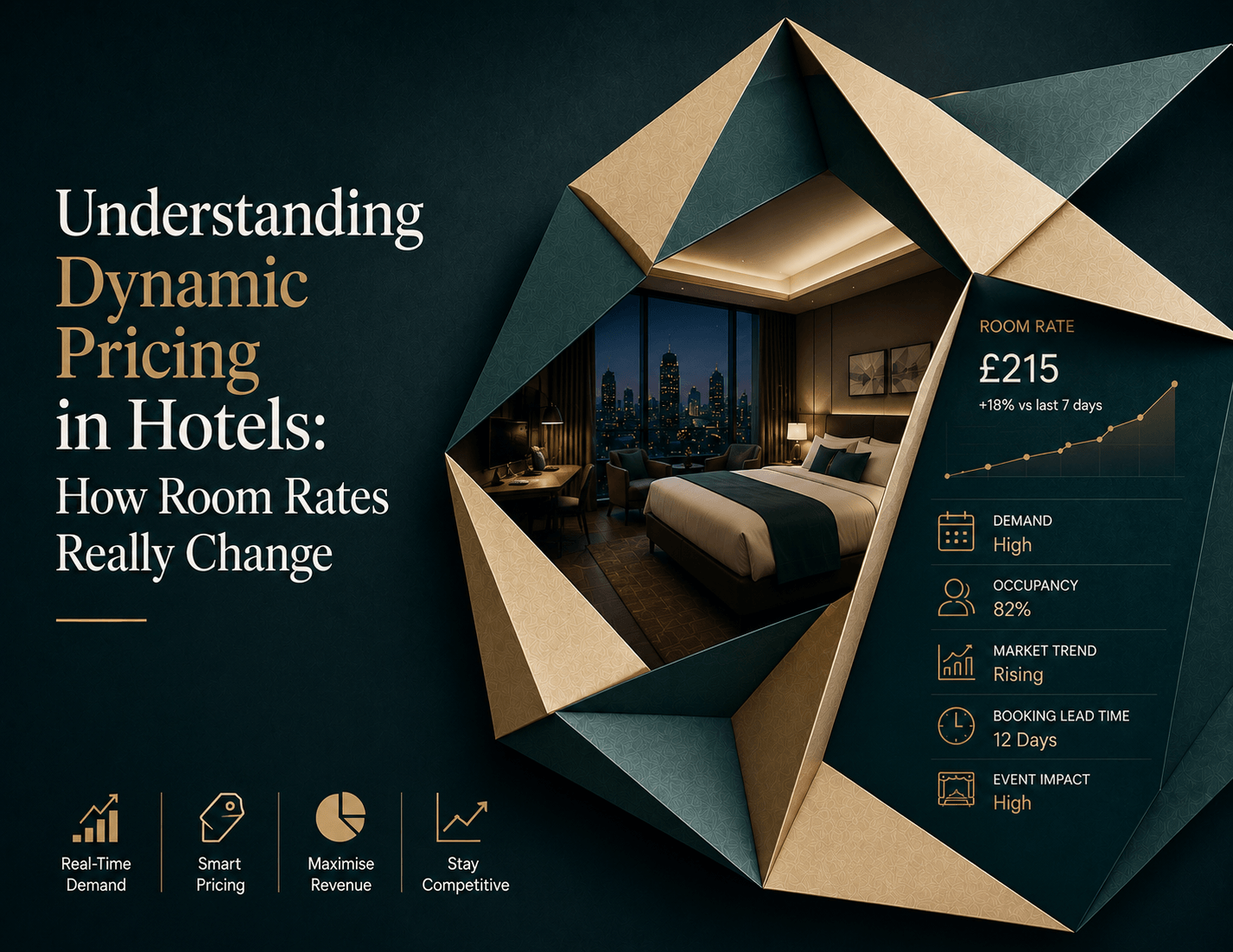
A hotel room can cost £140 on Monday, £175 by Wednesday and more than £250 as the arrival date approaches, even though the physical room has not changed. To guests, these price movements can appear unpredictable. In reality, the commercial value of the room is continually reassessed as demand, availability and booking behaviour develop.
Hotels have a fixed number of rooms to sell for each night. Once that night passes, an unsold room can never generate revenue for that date. Dynamic pricing allows hotels to respond to changing demand rather than committing to a single room price months in advance.
What Is Dynamic Pricing in Hotels?
Dynamic pricing is the practice of adjusting hotel room rates in response to changing demand and market conditions. Rates may increase, decrease or remain unchanged depending on how actual booking activity compares with expectations.
The objective is not simply to charge the highest possible price. Hotels aim to sell rooms at rates that reflect their expected commercial value at a particular stage of the booking cycle.
A hotel with 100 rooms could sell every room early at a heavily discounted price. However, this may be a poor decision if higher-paying demand is expected closer to arrival. Equally, holding prices too high for too long can leave rooms unsold.
Dynamic pricing helps hotels manage this uncertainty.
Why Hotel Room Rates Change
Supply and demand influence hotel pricing, but rates do not change simply because rooms are being sold.
Revenue teams examine booking pace, expected future demand, market segments, events, competitor activity and the amount of time remaining before arrival.
A hotel may increase prices while many rooms remain available if reservations are arriving faster than expected. Strong booking activity can indicate that higher-paying demand is likely to emerge later.
Rates can also fall as the arrival date approaches. If expected bookings fail to materialise, a hotel may reduce prices while there is still enough time to stimulate additional demand.
The key question is not simply how many rooms have been sold. It is how much demand the hotel expects before the remaining rooms lose their opportunity to be sold.
Booking Pace and the Hotel Booking Curve
Booking pace measures how quickly reservations are being received for a future arrival date.
Suppose a hotel normally has 40 rooms booked 30 days before a particular type of trading date. If it already has 65 rooms reserved, demand is developing faster than expected. The hotel may increase rates, restrict discounts or protect remaining rooms for potentially higher-value bookings.
Revenue managers often analyse this through the booking curve, which shows how reservations accumulate as the arrival date approaches.
Different customer segments have different booking patterns. Leisure guests may book months ahead, corporate travellers may reserve closer to arrival and group business can be contracted far in advance.
For this reason, 50% occupancy may represent strong or weak performance depending on when the rooms were booked and how much additional demand is expected.
Why Occupancy Does Not Determine Price on Its Own
A common misconception is that hotel prices automatically rise as occupancy increases.
Occupancy is important, but it must be considered alongside future demand.
A hotel that is 70% occupied three months before arrival is in a very different commercial position from one that reaches 70% occupancy at 8pm on the day of arrival. The amount of time remaining to sell the final rooms changes the commercial opportunity.
A hotel may increase rates at 50% occupancy if a major exhibition is approaching and bookings are accelerating faster than forecast. Another hotel could remain competitively priced at 80% occupancy because little additional demand is expected.
Dynamic pricing is therefore forward-looking. Hotels price remaining rooms partly according to the demand they expect to arrive next.
Best Available Rate and Hotel Pricing Levels
The Best Available Rate, commonly known as BAR, is generally the hotel’s publicly available flexible rate for a particular room type and date, subject to the property’s booking conditions.
As demand changes, the available BAR may also change.
Some hotels manage pricing through predefined rate levels. A standard room might have selling levels of £120, £140, £160, £190 and £230. When demand strengthens, the hotel moves to a higher pricing level. If demand weakens, a lower level may become available.
Modern Revenue Management Systems can support more granular pricing, allowing rates to move in smaller increments. The underlying principle remains the same: the available selling rate changes as the expected value of the remaining inventory changes.
Why Different Guests May Pay Different Room Rates
A change in BAR does not necessarily mean every hotel rate changes in exactly the same way.
Hotels usually offer rates with different booking conditions. Flexible rates, advance purchase offers, member discounts, packages and corporate agreements may all operate differently.
For example, an advance purchase rate may offer a discount against BAR. If BAR increases from £160 to £200, the discounted rate may also increase because it is linked to the hotel’s flexible rate.
A negotiated corporate agreement may instead provide a fixed price, while another company may receive a percentage discount from BAR.
Two guests can therefore pay different prices for the same room and night because of different contracts, booking conditions, cancellation terms or pricing structures.
How Events Influence Hotel Pricing
Conferences, exhibitions, concerts, festivals and major sporting events can increase accommodation demand within a limited period.
However, a large event does not automatically justify higher hotel prices.
A stadium concert may attract tens of thousands of people, but many attendees could live locally or travel home afterwards. An international trade exhibition with fewer visitors may generate greater hotel demand because delegates require accommodation for several nights.
Revenue teams therefore monitor actual booking behaviour rather than relying only on headline attendance.
If reservations accelerate and room availability across the destination declines, hotels may increase rates as stronger demand becomes evident.
The Role of Competitor Pricing
Hotels monitor competitor rates because guests can quickly compare accommodation across hotel websites, online travel agencies and metasearch platforms.
If comparable hotels begin increasing rates for a particular date, this may indicate that market demand is strengthening.
However, copying competitors blindly can produce poor pricing decisions.
A competing hotel may have accepted a large group, closed rooms for maintenance or adopted a strategy that is unsuitable for another property. Its higher price does not prove that the wider market will support the same rate.
Competitor pricing should therefore be treated as commercial intelligence rather than a direct pricing instruction.
Why Hotel Rates Can Change Several Times a Day
Hotel pricing information develops continuously.
New reservations reduce available inventory. Cancellations return rooms to sale. Booking activity may accelerate unexpectedly, while competitors can change their own pricing or availability.
In high-demand markets, a sudden increase in reservations can materially change the outlook for an arrival date within hours.
Hotels using automated Revenue Management Systems may identify these changes quickly and adjust pricing recommendations. Smaller properties may review rates manually several times a week.
Frequent price changes are not automatically evidence of sophisticated revenue management. Rates should move because meaningful commercial information has changed, not simply because a hotel has the technology to alter prices continuously.
Dynamic Pricing Across Different Room Types
Different room categories can develop separate demand patterns.
Standard rooms may sell quickly during high-volume periods while suites remain available. Alternatively, premium rooms may experience unusually strong demand from higher-spending guests.
Hotels therefore monitor booking activity by room category.
The price difference between room types can also change. If a standard room costs £200 and a superior room costs £220, guests may consider the additional £20 an attractive upgrade. If superior rooms begin selling too quickly, the hotel may increase the price difference to protect the remaining inventory.
Dynamic pricing can therefore affect both the base room rate and the price relationship between different room categories.
Do Hotel Prices Always Rise Closer to Arrival?
No. Hotel prices do not automatically increase as the arrival date approaches.
If demand develops strongly, prices may rise as the hotel fills and the expected value of the remaining rooms increases.
If demand underperforms, rates may fall because the hotel has limited time to attract additional bookings before unsold rooms lose their value for that date.
This creates a commercial decision for the hotel. Reducing prices too early may sacrifice revenue from guests who were willing to pay more. Waiting too long may leave insufficient time to generate additional demand.
Dynamic pricing provides a structured way to reassess this decision as new booking information becomes available.
The Role of Revenue Management Systems
Revenue Management Systems, commonly known as RMS platforms, support dynamic pricing by analysing hotel and market data.
These systems can examine historical demand, booking pace, cancellations, existing reservations and other information before producing forecasts and pricing recommendations.
More advanced systems use statistical models and machine learning to identify patterns that may be difficult to detect manually.
However, an RMS still depends on accurate data. Incorrect market segmentation, inaccurate inventory or inconsistent reservation coding can weaken pricing recommendations.
Technology processes information rapidly, while revenue professionals provide commercial oversight and assess whether recommendations make sense within the wider market.
The Risks of Poor Dynamic Pricing
Dynamic pricing can damage hotel performance when rate movements are based on weak analysis.
Aggressive discounting may increase occupancy while unnecessarily reducing average room rates. A hotel may attract guests at lower prices even when some would have booked at a higher rate.
Overpricing creates the opposite problem. A hotel may increase rates too aggressively because of an event, strong early bookings or competitor movements. If demand then slows, significant late price reductions may be required.
Effective dynamic pricing relies on controlled, evidence-based adjustments. The objective is not to move prices as aggressively as possible, but to position rates according to the best available understanding of future demand.
Conclusion
Dynamic pricing allows hotels to adjust room rates as demand, booking behaviour and market conditions change. Prices move because the commercial value of a room is not fixed throughout the booking cycle.
Booking pace, expected future demand, events, competitor behaviour and room-type availability can all influence pricing. BAR and pricing levels provide practical structures for translating these changes into the rates available to guests.
Dynamic pricing is therefore more sophisticated than increasing prices when occupancy rises or discounting rooms when demand falls. It requires forecasting, market analysis and an understanding of how demand develops before an arrival date.
Technology has made hotel pricing faster and more granular, but accurate data and commercial judgement remain essential. The purpose of dynamic pricing is not constant price movement. It is to make better pricing decisions as the commercial value of hotel inventory changes.
Disclaimer: Content published on Hotel Magazine may include contributions from guest authors, industry professionals, and external experts. The views, opinions, and analysis expressed in individual articles are those of the respective authors and do not necessarily reflect the views, policies, or editorial position of Hotel Magazine. While every effort is made to ensure accuracy and relevance, readers should independently verify information and seek professional advice where appropriate.